
Compare Knox County Value Types
Value labels are not interchangeable. Indiana assesses real property at a 100 percent assessment level under its market value-in-use standard, so the assessed figure answers one question. A recorded deed states one transaction fact. A professional appraisal, meanwhile, is a separate opinion tied to a stated date and purpose.
| Value type | Meaning | Record source |
|---|---|---|
| Assessed value | Administrative value under Indiana assessment rules | Assessor roll and Form 11 |
| Market value-in-use | Indiana's assessment concept based on a property's use | DLGF guidance and assessment record |
| Recorded sale | Transaction evidence, not the automatic next assessment | Deed and verified sales record |
| Land and improvements | Components supporting the parcel's total value | Engage detail and assessment file |
A recent sale price can diverge from the assessed value. The two figures answer different questions and often carry different effective dates.
Interpret Knox's Valuation Field
One sample parcel showed a Valuation field of 23,700 in an Engage result. The screen never said what that lone figure meant. It could be a gross assessed value, a land-plus-improvement total, or a single year's number. Assign no meaning the display does not supply. The official parcel detail shows where each supporting section appears for a selected parcel.
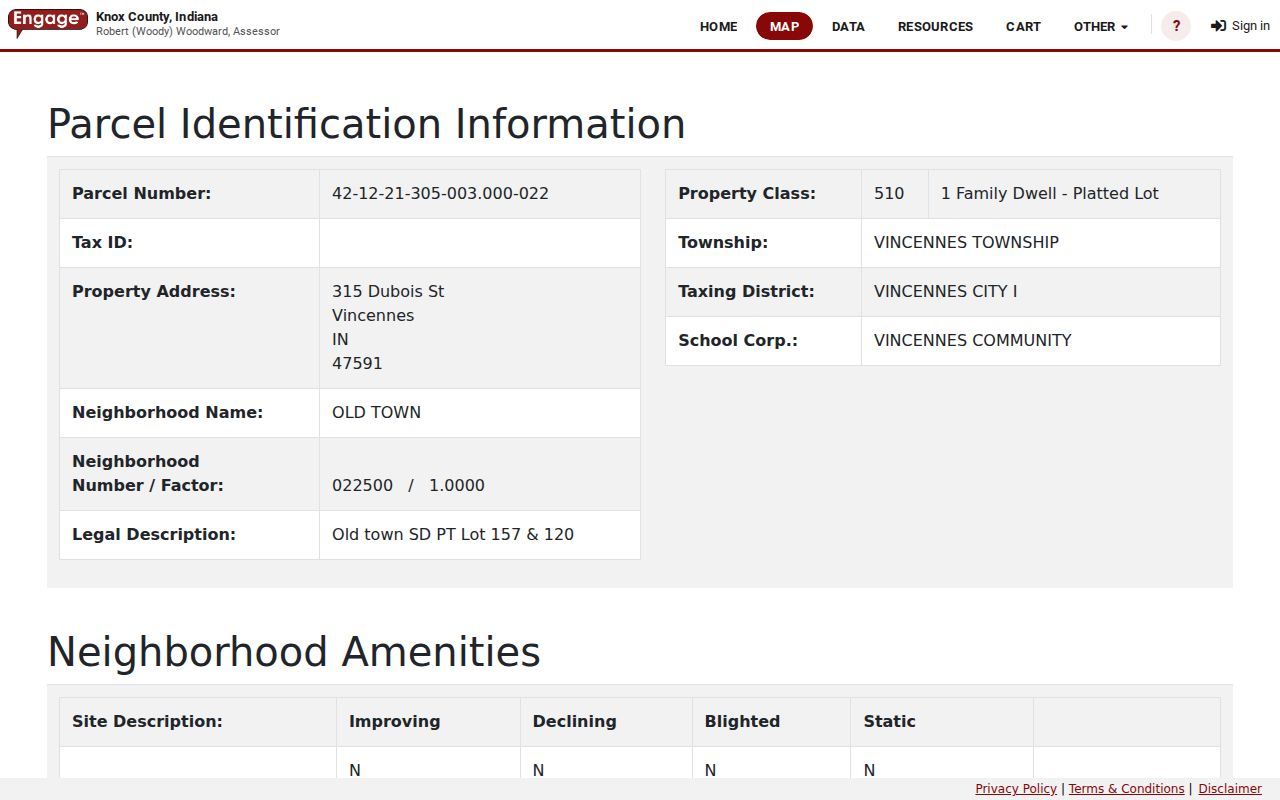
Read the live labels and Form 11 before naming any figure. Values and portal displays change, so save the query date.
Estimate from Knox Assessment Records
The Engage portal accepts an owner name, address, or Property Number and opens a parcel detail with Valuation List, Land Info, Improvement Info, Transfer History, and Sales List headings. Always capture the displayed year and label.
- Search the street address and copy the full Property ID.
- Open Detail and record the valuation year, land, improvement, and total labels actually shown.
- Compare any Sales List lead with the Recorder's deed and recording date.
- Use nearby parcels only as context, not as an appraisal formula.
- Assessed value
- The official value produced for property assessment.
- Market value-in-use
- Indiana's value concept for the property's current use.
- Assessment level
- The statutory relationship used in assessment; Indiana states a 100 percent level.
- Consideration
- The value stated in a transfer instrument when present, not always a simple open-market price.
- Reassessment
- A review that updates property characteristics and value.
Track Knox Reassessment Timing
Indiana guidance separates two different clocks. A four-year cyclical reassessment puts staff on the ground verifying physical characteristics, while annual trending uses prior sales and other market evidence to adjust values between cycles. The assessment date matters as much as the amount shown. A current portal date does not mean every property was inspected that day. Use the Indiana DLGF assessment process page to interpret statewide rules, then ask the Knox County Assessor about the local record and its effective year.
Compare Knox Sale Evidence
A deed may state its consideration. Engage detail includes Sales List and Transfer History headings. The portal publishes no exact public last-sale price field for the sample parcel. Obtain the instrument from the Knox County Recorder. Do this before treating a portal value as the price paid. A sale can involve family, estate, partial-interest, or trustee terms. Those terms can make a raw amount a weak market comparison. Confirm the deed type, date, parties, and legal description before relying on it.
Note: A recorded transfer fact does not automatically become the next assessed value.
Separate Knox Land and Improvements
Engage detail separates Land Info from Improvement Info. Those components explain how the parcel total is built. Check whether the record reflects structures, additions, demolitions, or land characteristics shaping the current assessment. When a figure seems wrong, compare it with the property record card and Form 11. The GIS sketch and parcel outline help locate the tract, but neither proves building condition or a legal boundary. Direct factual corrections to the Assessor.
Distinguish Knox Tax Treatment
The Knox Auditor links homestead, mortgage, over-65, and blind or disabled exemptions. These change taxable treatment. They do not redefine market value-in-use or prove who occupies the land. An exemption flag is an administrative indicator, nothing more. The tax bill, payments, and balance belong to the Knox County property tax records workflow. Keep that bill analysis separate from the meaning of assessed value.
Review a Knox Value Difference
A value that looks inconsistent deserves a methodical check. First verify the parcel identity. Check the assessment year, land and improvement data, and any sale used as context. Then ask the Assessor for the relevant record and calculation basis. Indiana Form 11 supplies assessment notice context. A formal dispute begins locally with the Assessor. The Property Tax Assessment Board of Appeals hears it under the published schedule. State Form 130 is the initial appeal form. Indiana Board of Tax Review procedures follow if the matter stays unresolved. Those steps challenge an assessment, not a GIS line or a private asking price.
Limit Knox Property Value Claims
The Assessor applies mass-appraisal methods across thousands of parcels. A value card is not an inspection, a title opinion, or a survey. It is no promise of sale price. Condition changes and market timing can pull an assessment away from a private appraisal.
Document the source, assessment year, query date, parcel number, and exact label beside every figure. If two official records differ, compare their effective dates before deciding one is wrong. Ask the Knox County Assessor to explain its record. Use the Recorder for the transfer instrument. Neither a tax balance nor a GIS polygon supplies an independent market appraisal.
For purchase planning, weigh current condition and recent verified transfers, then seek qualified advice. A portal snapshot alone cannot account for every repair or easement. It may also miss use limits and transaction terms that shape price.
Value is not price. A Knox County assessed value is not a prediction of what a parcel will sell for. Obtain a licensed appraisal when a transaction requires one.