
Knox Deeds and Their Roles
The Knox County Recorder handles the recording of deeds, mortgages, mechanic's liens, releases, plats, and UCC filings. A deed documents a transfer as stated. The deed type offers a hint about what happened. The instrument's own language and the chain of documents around it still control the analysis. Knox County publishes no complete online deed-type menu. Read each deed from the instrument itself. The Recorder page lists the office's record categories and its official contact routes.
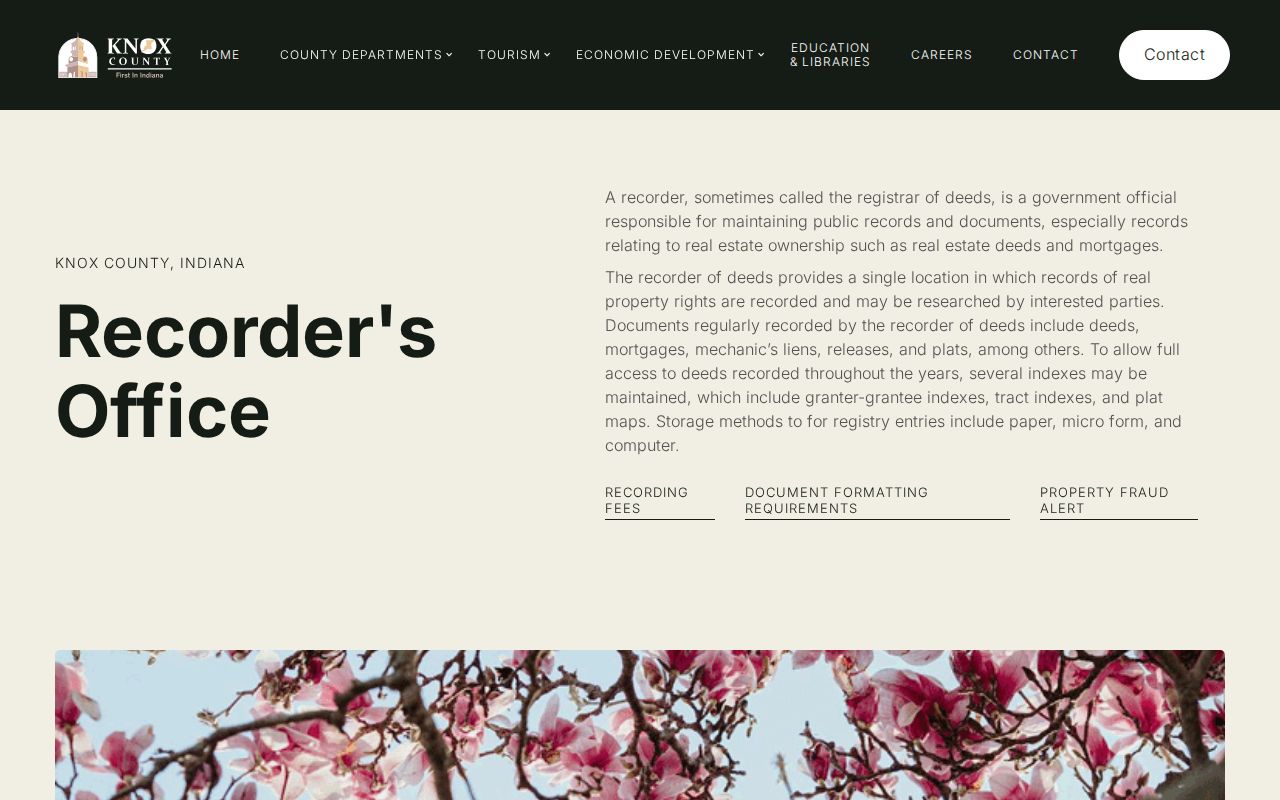
The Recorder page itself displays the office route and the categories it records. It is not a deed index.
| Deed Type | What It Does | Common Use |
|---|---|---|
| Warranty deed | Conveys the stated interest with written title promises | Ordinary sale or transfer |
| Quitclaim deed | Conveys whatever interest the grantor holds | Family transfer or title cleanup |
| Executor or administrator deed | Transfers property under estate authority | Probate sale or distribution |
| Trustee deed | Conveys through a trustee's stated authority | Trust or authorized sale |
| Tax deed | Records a completed tax-sale transfer | Delinquent-tax proceeding |
Mortgages and liens record claims against the land, not a new owner of record. A release should be matched to the claim it discharges. A plat maps lots, streets, dedications, and easements in one drawing. When the task goes beyond the transfer, search the related instrument series as well.
Access Knox Recorder Indexes
Knox describes both grantor-grantee and tract indexes. The Recorder publishes no public search URL or image viewer. Visit the Suite 2 counter at 111 N 7th Street in Vincennes, call 812-885-2508, or email KHopwood@knoxcounty.in.gov or kcr@knoxcounty.in.gov. A focused Indiana Access to Public Records Act request works as another route to the deed records.
| Index key | Request detail | Purpose |
|---|---|---|
| Grantor | Exact name, variants, date range | Find an outgoing transfer |
| Grantee | Buyer or recipient name | Find an acquiring deed |
| Tract | Parcel and legal description | Follow land despite name changes |
| Document | Type and recording interval | Narrow the record set |
| Reference | Book/page or instrument number | Retrieve a known filing |
Ask staff whether you are getting an index entry, an image, a plain copy, or a certified copy of the deed. Those products are not interchangeable. A missing web result does not mean no deed exists in the Knox County records.
Walk Knox Grantor-Grantee Indexes
A chain of title links every instrument touching the same land. Start with the assessor Owner Name and parcel number. Then obtain the deed that brought the parcel to that grantee. That deed's grantor is your next lead. The walk repeats until the chain fades. Compare the legal description at each step. One person may have held several Knox County tracts.
- Search the current owner as grantee and identify the latest deed for the right land.
- Record grantor, grantee, date, deed type, and book/page or instrument number.
- Search that grantor as a grantee in an earlier period and match the description.
- Repeat, moving into older deed books or microfilm when the index run changes.
- Grantor
- The party transferring the stated interest.
- Grantee
- The party receiving it.
- Chain of title
- The ordered sequence of instruments for the same land.
- Book and page
- A volume location for a recorded document.
- Instrument number
- A unique recording reference.
The Recorder page spells it "granter-grantee" once. Use standard grantor-grantee wording with staff. Keep the page spelling handy if it helps identify the index, since initials, suffixes, trusts, companies, and estates may each need separate name searches in the Knox County deed records.
Follow Knox Historic Deed Books
Knox County was organized in 1790. The Vincennes federal land office opened in 1807. The Indiana Archives purchaser index can return land office, purchaser, date, legal description, acreage, and certificate details for early entries. That federal layer predates the county deed books and complements them.
The State Library microfilm guide lists general deed indexes covering 1814 to 1860, 1860 to 1877, 1878 to 1892, and 1892 to 1901, plus later deed volumes. Those films sit offline. Cite the exact film, volume, and page you use.
No courthouse loss or imaging-cutover year is published. Never invent one to explain a gap. Ask the office whether the name, tract, book, or microform index is the right next channel for your deed search.
Match Knox Land Descriptions
Old Knox County deeds rarely carry modern parcel numbers. Match the land description itself. A 2026 Vincennes legal notice supplies real Knox vocabulary, with subdivision, addition, lot, block, acreage, section, township, range, and bearings appearing alongside Old Town, L.J. Cooper's, Reel and Swartzel's, Caldwell's 2nd Addition, Cochran's Addition, and Vincennes Commons.
The Caldwell description nests partial lots inside an addition and then inside Division A of Vincennes Commons Lands. A Cochran parcel blends part of a lot with course-and-distance calls. The Caldwell and Cochran examples show why a street address or shortened lot phrase cannot replace the full legal description in the deed records.
Recorded plats turn lot language into mapped relationships. Historical maps can orient an old tract. Current GIS stays reference geometry. Neither map source replaces the deed text or a licensed survey of the Knox County parcel.
Check Knox Deed Alerts
The Recorder links the free Property Fraud Alert service. A user picks Knox County, accepts the disclaimer, and enters the exact indexed name without suffixes. A matching new record can trigger an alert listing county, document number and type, recording date, and party name. An alert is a lead, not a title opinion. It can miss a spelling variant. It does not reach another county automatically. Confirm any notice with the Recorder before acting, and do not confuse a paid deed-copy mailer with the county-linked service.
Connect Estates to Knox Deeds
Estates move Knox County land in several ways. An executor deed, administrator deed, or probate sale can transfer title. So can a trust, a court order, or survivorship language in an older deed. When you trace one, search the decedent, the estate, the fiduciary, any heirs, and the buyer in both Recorder files and court records. Always match the parcel number and legal description. A shared last name proves nothing on its own.
The Knox County Clerk keeps probate files and the permanent historical court records. Indiana MyCase sometimes lists a public docket. Older or complete files may still require a visit to the clerk. A death certificate only records the death itself. It cannot convey land. The transfer must rest on a recorded instrument or on court authority.
Note: Keep the proof of death and the transfer trail apart until a deed, order, trust term, or survivorship clause actually links them.
Order a Knox Deed Copy
You can order a Knox County deed copy by party or parcel. You can also use a legal description, recording date, or a known reference. Plain copies run $1 per page for anything up to 11 by 17 inches. Larger copies cost $5 per page, and certification adds $5 per document. A one-name search through the Recorder is $7, with each additional name at $5. Confirm prices and turnaround before you order.
If you plan to file rather than fetch, the Recorder charges a $25 filing fee. It covers deeds, UCC filings, and similar documents. Recording requirements are specific. Deeds need a proper acknowledgment. They also need typed names beneath signatures and notary details. Set margins and paper size, a preparer statement, and the grantee's name and address round out the rules. A complete Social Security or personal identification number is not allowed. Deed transfers for tax purposes also require Auditor endorsement and a Sales Disclosure form.
A plain copy usually works fine for research. Courts, agencies, and transactions often want a certified copy instead. Paper and microform records may take longer to pull than computer-indexed ones.
Recorded, not guaranteed. Knox County deed records show what reached the Recorder. They do not establish clear title, resolve every unrecorded interest, or replace a legal title opinion.