
Reconstruct Knox County Owner History
A backward deed chain is a timeline rather than a loose list of names. Each entry should capture the transfer date, the parties, the instrument type, and the citation that links it to the row before it.
| Transfer stage | Party path | Record type | Citation to keep |
|---|---|---|---|
| Current deed | Prior owner to present grantee | Warranty, quitclaim, trustee, or other deed | Recording date and document or book/page |
| Prior deed | Earlier grantor to prior owner | Same legal description or predecessor tract | Earlier book/page reference |
| Estate interval | Decedent or fiduciary to successor | Probate order and transfer instrument | Case and Recorder citations |
| Original purchase | Federal sale to purchaser | Vincennes land-office entry | Certificate, tract, land office, and date |
Start from the newest deed that clearly matches the parcel. When a link in the chain goes blank, work through name variants, legal descriptions, probate files, and predecessor parcels instead of guessing at an owner.
Knox Deed Indexes Reach 1814
The Indiana State Library microfilm finding aid covers General Index of Deeds volumes 1 through 6 for 1814 to 1860. It continues with volumes 7 through 9 for 1860 to 1877. Volumes 10 through 12 cover 1878 to 1892. Volumes 13 through 14 run from 1892 to 1901. Late nineteenth-century deed-record runs extend through 1901 as well. These are historic holdings on film, not a searchable web index. The Knox Recorder publishes no online deed index with a stated starting year. So plan on the Recorder counter, the State Library, a local library, or the FamilySearch catalog. The Recorder counter is one option. The State Library and a local library are others. FamilySearch may also have relevant reels. Confirm the volume and reel before ordering anything.
No verified web cutoff. Older former owners remain available through deed books and microfilm even though public online coverage was not established.
Walk Knox Deeds Backward
Take the most recent deed tied to the parcel as your starting point. Read the grantee, the legal description, the date, and any prior instrument references. That deed's grantor then becomes the grantee in your next search.
- Find the present owner's acquisition deed through the Knox County Recorder.
- Copy the grantor and complete legal description.
- Search that grantor as an earlier grantee, allowing for initials and spelling variants.
- Record every citation and move to the correct historic index volume when required.
- Grantor
- The party transferring an interest.
- Grantee
- The party receiving that interest.
- Chain of title
- The linked sequence of instruments affecting ownership.
- Reverse index
- An index route used to follow parties backward.
- Quitclaim
- A deed conveying whatever interest the grantor has, without a title warranty.
Follow Knox Legal Descriptions
Old deeds often leave out today's parcel number and street address. Track the lot and block in a named addition. The tract may sit in a government survey or use metes-and-bounds courses and distances. Some parcels descend from only part of a larger tract. This often follows a split. A 2026 Vincennes notice shows how layered these can get. One description nested parts of Lots 25 and 26 in Caldwell's 2nd Addition inside Division A of Vincennes Commons Lands. Another covered part of Lot 190 in Cochran's Addition with full bearings and distances. Copy the whole description. Shortening it can sever the historical link.
Note: A street name points to place. The legal description carries the land's identity across time.
Separate Knox's First Land Layer
Knox County was organized in 1790. Indiana's first federal land office opened at Vincennes in 1807. The Indiana Archives land index can supply the original purchaser, the land office, and the purchase date. It also covers township, range, section or lot, acreage, and certificate details. That federal entry begins a trail distinct from later private deeds. It does not list every former owner between the original purchaser and today. Connect it to county deed books through matching tract descriptions and documented conveyances.
Match Knox Plats and Maps
The State Library Knox map catalog lists owner-bearing Vincennes maps from 1792, 1803, 1805, 1816, 1820, and about 1837, plus an 1875 county map and modern atlases.
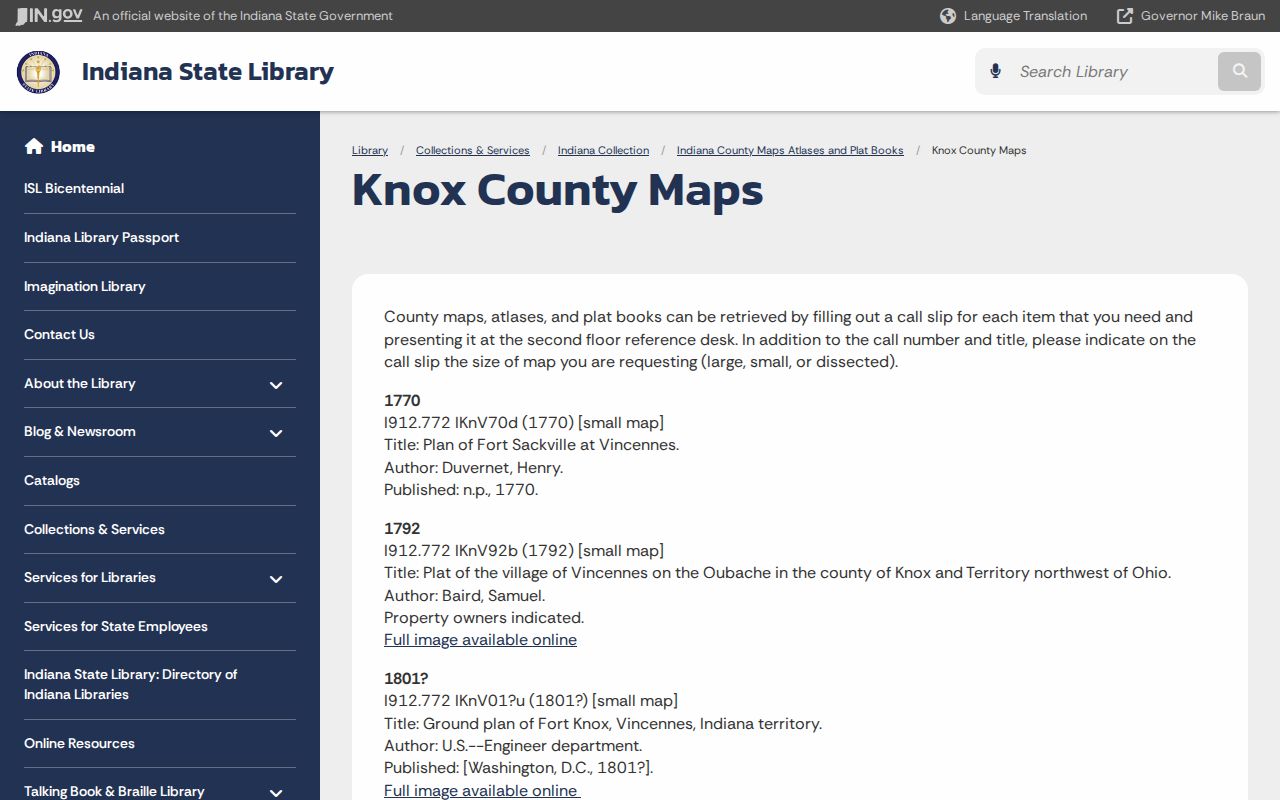
Treat map names and owner labels as clues rather than substitutes for deeds. To request originals, the catalog directs visitors to a second-floor reference-desk call slip with the map size specified.
Bridge Knox Estate Transfers
A prior-owner sequence may run through probate, survivorship, a trust, or a court order rather than a straightforward sale. Search the decedent, the estate, the executor, the administrator, and the heirs in the Knox Clerk file and Indiana MyCase. Then locate the recorded instrument that actually moved the land. The State Library guide identifies Knox probate abstracts and wills spanning 1806 to 1955. It also notes a digital 1832 to 1835 collection. A death record helps confirm identity and timing. It does not transfer title.
Recover Knox Owner Clues
The Knox County Public Library newspaper archive can bridge gaps the deeds leave open. Try a surname paired with a street, addition, probate, sheriff, sale, plat, or ordinance term. A single notice may surface an executor, an affected tract, or an old road name. That name can unlock the next official search. Local help also comes from the McGrady-Brockman House, Browning Genealogy, and the Byron R. Lewis Historical Library. City-directory coverage varies. Ask a librarian for a catalog record before counting on a run of directories.
Know the Knox Chain Limits
The general deed indexes begin in 1814. The federal land-office layer reaches to 1807, and county history starts in 1790. Those dates do not promise an unbroken trail for every parcel. Name changes, probate, trusts, parcel splits, and shifting address language can all interrupt prior-owner research. Record each unresolved interval and every source you checked. A legal conclusion may call for a professional title examination. See Knox County deed records for instrument details. For the modern starting point, see current-owner records.
Keep a research log with each grantor, grantee, instrument type, recording date, book or document number. Add the exact legal description too. Note whether the evidence came from an original book, microfilm, a portal, or a newspaper. Staff responses count as well. That record makes any break visible. It also keeps a similarly named person from slipping into the wrong Knox County chain.
Lawful use. Former-owner research supports house history, estate work, and property diligence. Never use it to track, harass, intimidate, or harm anyone.